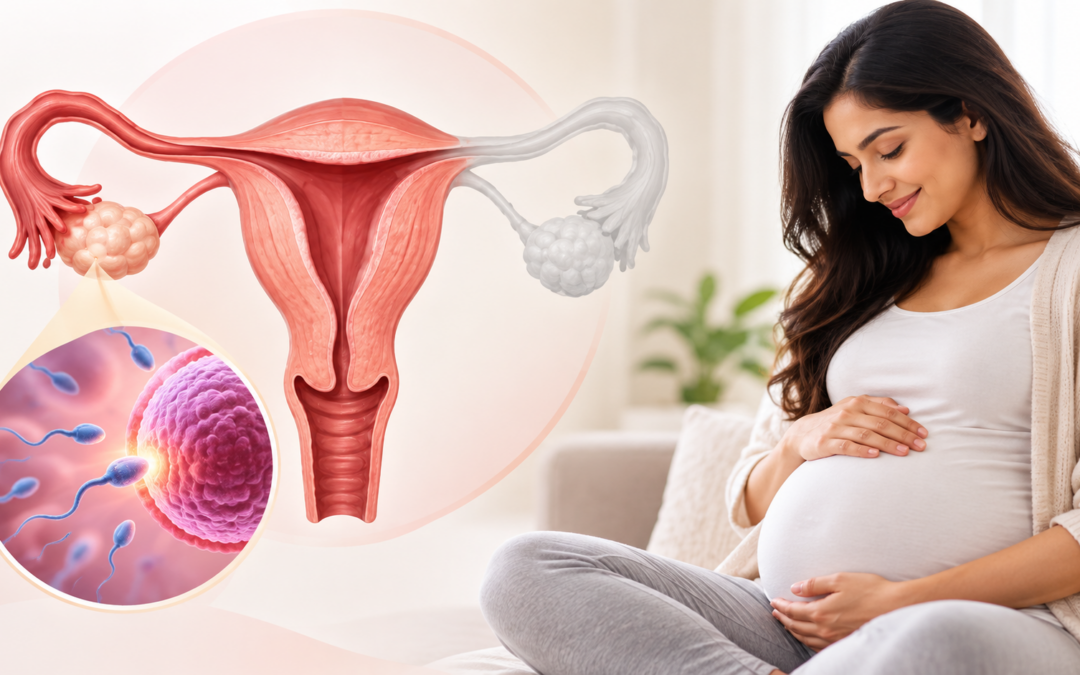
Yes, you can. As long as the remaining tube and its side ovary are working properly. Ovulation switches between the ovaries most cycles, and a healthy tube on either side can usually pick up an egg no matter which ovary released it. Odds per cycle drop a bit compared to having two working tubes, but nowhere near as much as most people assume. What actually matters is the condition of that one tube. Not the fact that there’s only one of it.
According to Dr. Pooja Papishetty, a fertility specialist at a leading IVF Centre in Kondapur, “One healthy tube is usually enough, honestly. What actually blocks conception is a tube that’s scarred or half-closed and still gets marked normal on a routine scan.”
Worried your remaining tube might be affected rather than just outnumbered?
Does Having One Fallopian Tube Lower Your Monthly Chances?
Ovulation doesn’t switch sides on a neat schedule. It’s not that predictable, and that’s honestly where most of the reduced odds come from.
- Ovulation pattern: Some months the egg comes from the ovary on the same side as your working tube, some months it doesn’t, and on those off months the tube just sits there doing nothing.
- Egg pickup: Fimbriae at the end of a healthy tube can occasionally stretch across the pelvis and catch an egg released from the opposite ovary. It sounds unlikely. But it’s documented in more than a few clinical case reports.
- Cycle timing: Couples with one tube sometimes need 12 to 18 months instead of the standard 12. That stretch on its own isn’t a red flag.
- Age factor: A woman in her late twenties with one tube generally beats a woman past 38 with two, because egg quality pulls just as much weight as tube count. Sometimes more.
So if a year of trying naturally hasn’t gone anywhere, IUI treatment is usually the sensible next step before anything bigger comes into the conversation.
When Does One Fallopian Tube Need Medical Treatment Instead?
Not every single-tube case sorts itself out. Some genuinely need intervention before pregnancy becomes realistic.
- Hydrosalpinx: A fluid-filled remaining tube can leak backward into the uterus and quietly lower implantation rates, even when the tube looks perfectly fine on ultrasound.
- Post-ectopic removal: Losing one tube to an ectopic pregnancy puts more pressure on the side that’s left, and its health becomes the one variable that matters most from here on.
- Scar tissue: Old pelvic infections or past surgery can leave adhesions that restrict tube movement without blocking it outright. Only a direct look confirms that, not a scan.
- Combined factors: PCOS, low ovarian reserve, or a male factor issue stacked on top of one tube changes things considerably. Because now there’s more than one variable to plan around.
A proper hysteroscopy evaluation before treatment starts often changes the whole plan.
Why Choose Dr. Pooja Papishetty for Fertility Care With One Tube?
Dr. Pooja Papishetty, MBBS, MS Obstetrics and Gynaecology, Fellowship in Reproductive Medicine from Bedi Hospital Chandigarh, has close to five years of focused fertility practice behind her, covering tubal factor infertility, IUI and IVF planning. She’s a FOGSI and IMA member, and she personally checks tubal status herself before recommending anything. Not just going off a scan report someone else read.
Patients walk in anxious about having one tube. They usually walk out with a realistic, individualised timeline instead of vague reassurance, and that’s the part that actually changes how people plan their next few months.
Call +91 7780612539 to book your consultation.
Frequently Asked Questions
Can you get pregnant naturally with only one fallopian tube?
Yes, if that tube and its corresponding ovary are healthy and open.
Does IVF work if I only have one fallopian tube?
Yes, IVF bypasses the tubes entirely by fertilising eggs outside the body.
How long should I try naturally before seeking help?
Around 12 months, or 6 months if you’re over 35.
Can a blocked remaining tube still allow pregnancy?
Rarely. A blocked single tube usually needs treatment or IVF.
References
- Unilateral Partial Absence of the Fallopian Tube: A Case Report and Literature Review
- Salpingectomy as a fertility-enhancing procedure before ART: a systematic review
Disclaimer: This blog is for educational purposes only and is not a substitute for professional medical advice.